02 / Product
My Local Loop
Two-Sided Marketplace / Local Commerce
A two-sided local commerce marketplace where businesses join by giving exclusive value, not paying marketing fees, and residents subscribe to discover and redeem it.
Public / Local commerce
↔ Drag1918 × 1249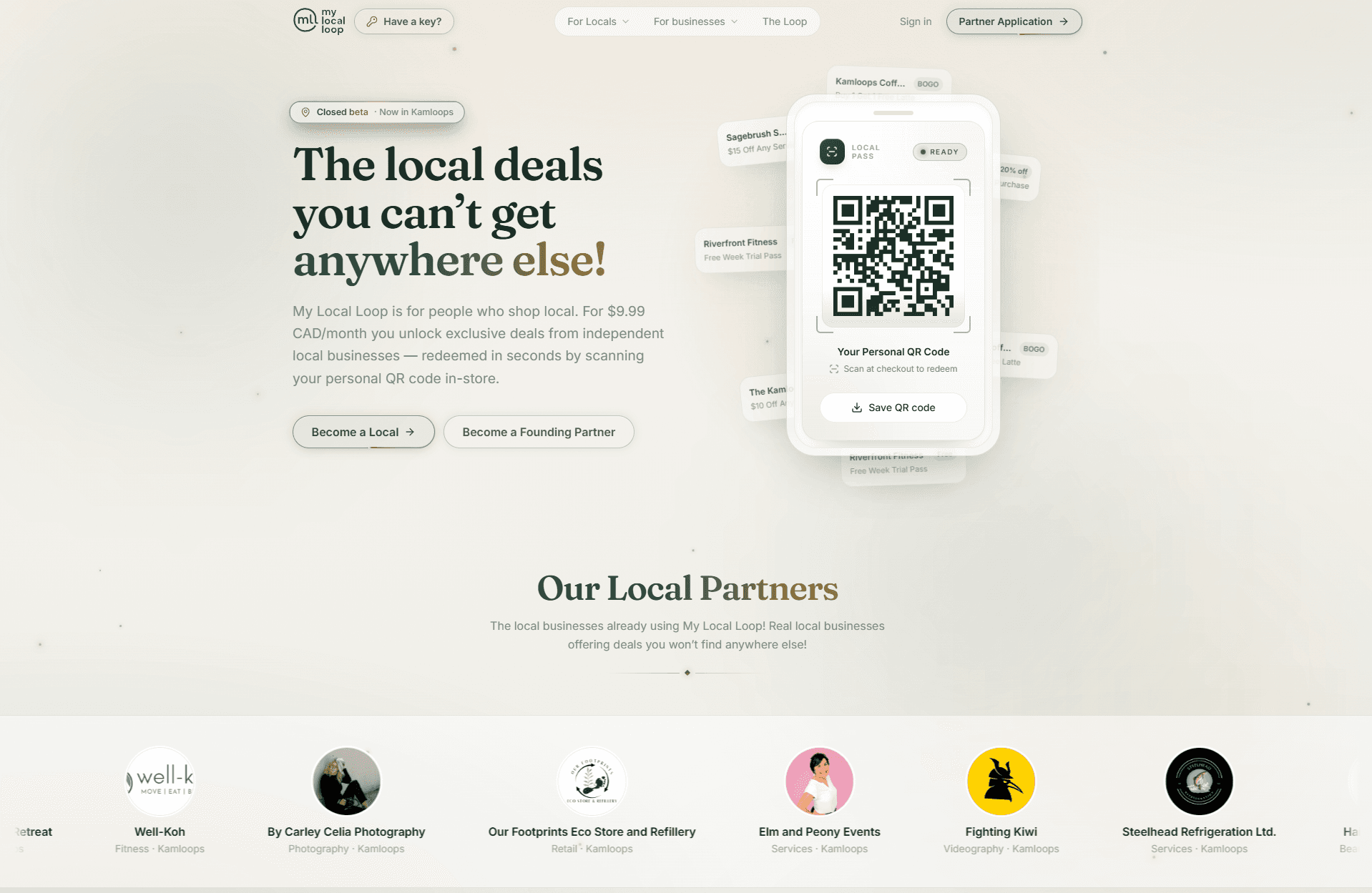
01 / The Problem
Independent businesses compete against budgets they can't match.
Independent local businesses increasingly compete against major chains, conglomerates and online retailers with marketing budgets they cannot realistically match.
Traditional coupon systems don't solve this well. Most local businesses still lean on in-store promotions, social media, flyers, manually distributed coupons and printed coupon books.
Where the coupon book breaks
- 01Businesses often pay just to participate
- 02Offers are static once printed
- 03A business may get only one or two placements
- 04Offers can't easily be changed
- 05Redemption is difficult to measure
- 06The customer has to carry a physical book
- 07Little connects a redemption to repeat behaviour
What if the business didn't have to
pay for the marketing platform at all?
02 / The Idea
So we flipped who pays — and what they pay with.
My business partner and I had both watched independent “Mom & Pop” businesses struggle as consumer spending moved toward major chains, conglomerates and online retailers.
We wanted something that could help local businesses generate traffic and repeat customers without another advertising expense. So the model was intentionally inverted. Consumers fund the platform through a subscription — $9.99 CAD a month today, planned to move to $14.99.
Instead of the business paying the platform,
the business pays with value.
Traditional
Business pays the platform to advertise a discount
My Local Loop
Business gives exclusive value; the Local pays for access
Partners contribute
Exclusive offers
Locals contribute
A subscription
The marketplace
Connects the two
03 / The Marketplace Loop
Every redemption is a reason to make the next offer.
No side is paying the other in the usual sense. Partners contribute value, Locals contribute a subscription, and each completed redemption feeds the reason for the next one — which is what keeps the loop turning.
- ProvidePartners post offers01
- DiscoverLocals find value02
- VisitThe business03
- RedeemThe Local Pass04
- DataTraffic + signal05
- CreateNew offers06
- ReturnThe Local comes back07
- The Loop — the loop continues
04 / Two Sides, One Product
One marketplace, built as two products that never overlap.
My Local Loop is effectively two connected applications running against one marketplace: the Local, and the Partner. They mirror each other in structure and share almost nothing in permission.
Local / Demand
Subscribe, discover, redeem.
- Create an account and subscribe through Stripe
- Browse active offers and participating businesses
- See nearby businesses on a map
- Search and filter deals
- Track savings, coupon usage and frequent visits
- Carry a Local Pass — a unique QR and manual code
Partner / Supply
Apply, get approved, go live.
- Submit a Partner Application with a proposed baseline offer
- Get reviewed in the admin portal, then redeem an emailed key
- Onboard — gated behind creating the baseline offer
- Build offers: discounts, imagery, dates, limits
- Track redemptions, repeat customers and revenue attributed
- Manage the storefront and scan the Local Pass
05 / The Local Experience
The consumer product, at a glance.
Once onboarded, the Local enters a portal built to make value effortless to find. It leads with the number that matters to a subscriber — what they've saved — and surrounds it with active deals, nearby businesses, high-traffic hours and the newest offers.
Local / Dashboard
↔ Drag2046 × 1262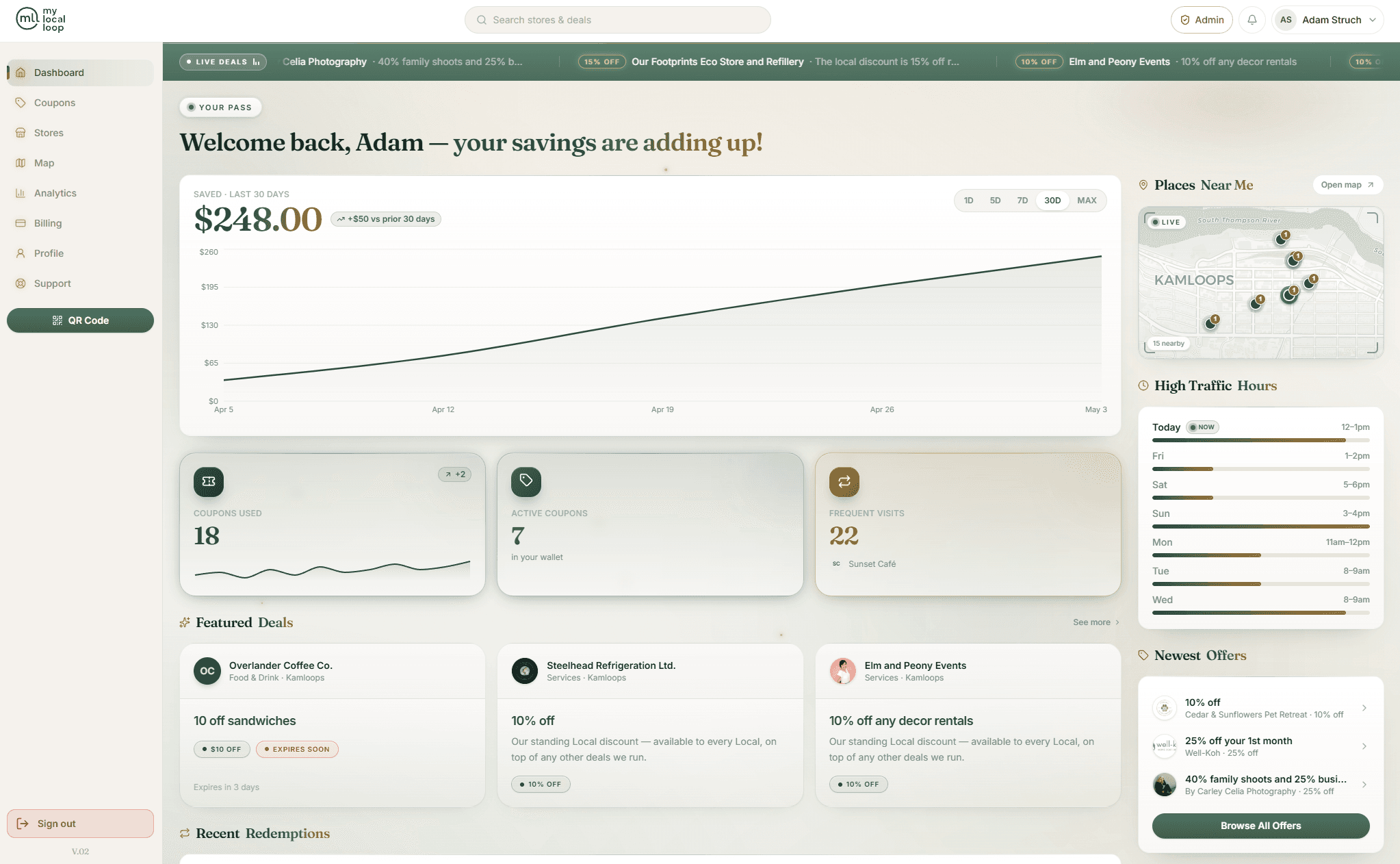
06 / The Design
Built for people who don't call themselves technical.
A coffee shop owner, a photographer, a fitness studio, a retailer, a shopper — none should need experience with complex SaaS to understand the platform. The interface prioritises clear navigation, few steps, readable information, large targets and obvious primary actions.
It deliberately moves away from the stereotypical dark SaaS aesthetic. Forest green, cream, warm gold, soft sage and white give it an identity that reads local and approachable rather than clinical — and the responsive site behaves close to an app while the dedicated app is in development.
Colour
Type
Local
A soft serif-adjacent display over a plain interface face, sized for people who don’t consider themselves technical.
Aa — UI label / mono
Surface
Coupons used
18
Action
Large targets / obvious primary
Principles
- 01Clear navigation over feature density
- 02Minimal steps to a primary action
- 03Large, obvious interaction targets
- 04Strong, predictable hierarchy
- 05Mobile-first, responsive across every surface
Local / Discovery
↔ Drag2039 × 1262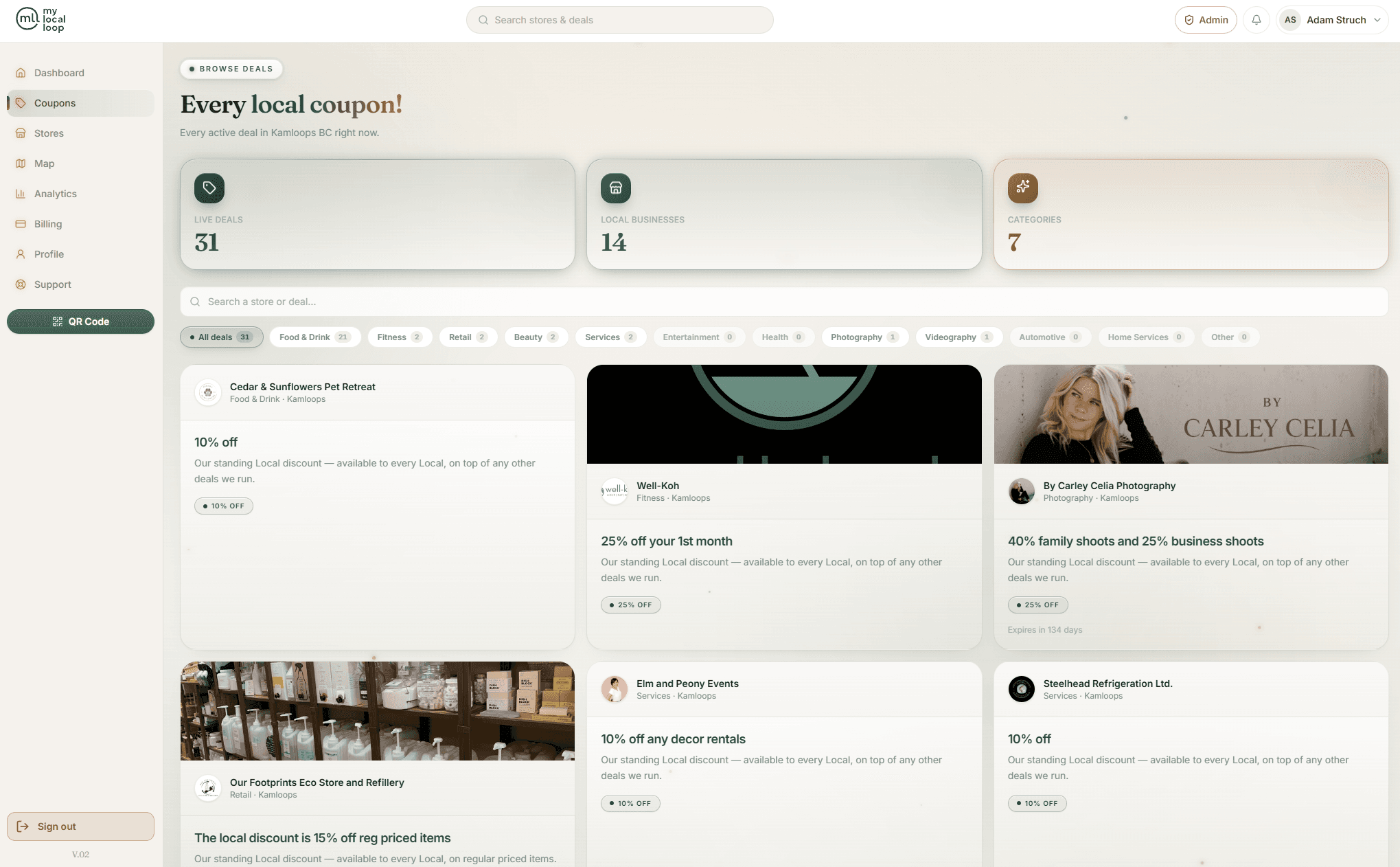
Local / Nearby
↔ Drag2037 × 1261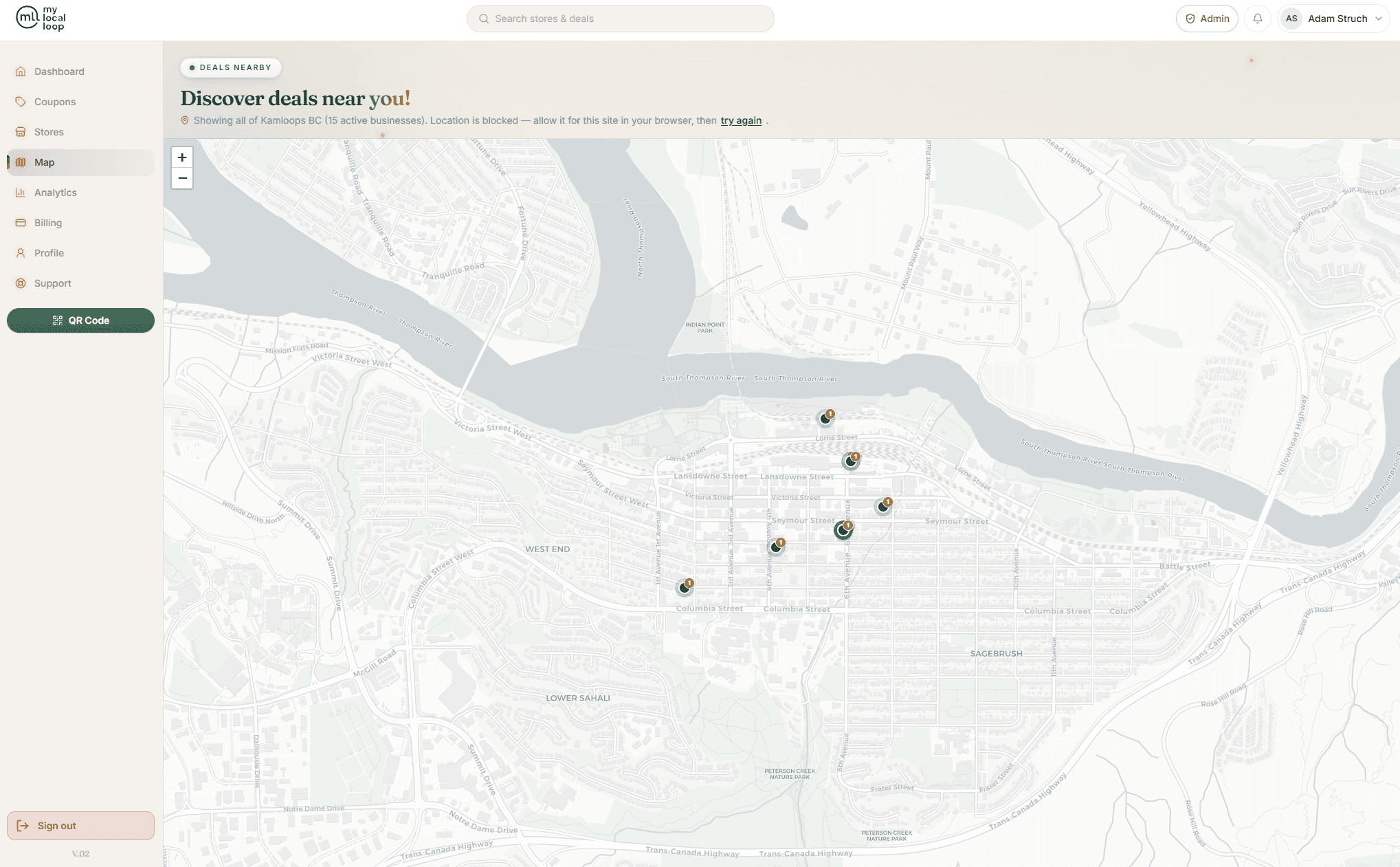
Local / Savings
↔ Drag2037 × 1260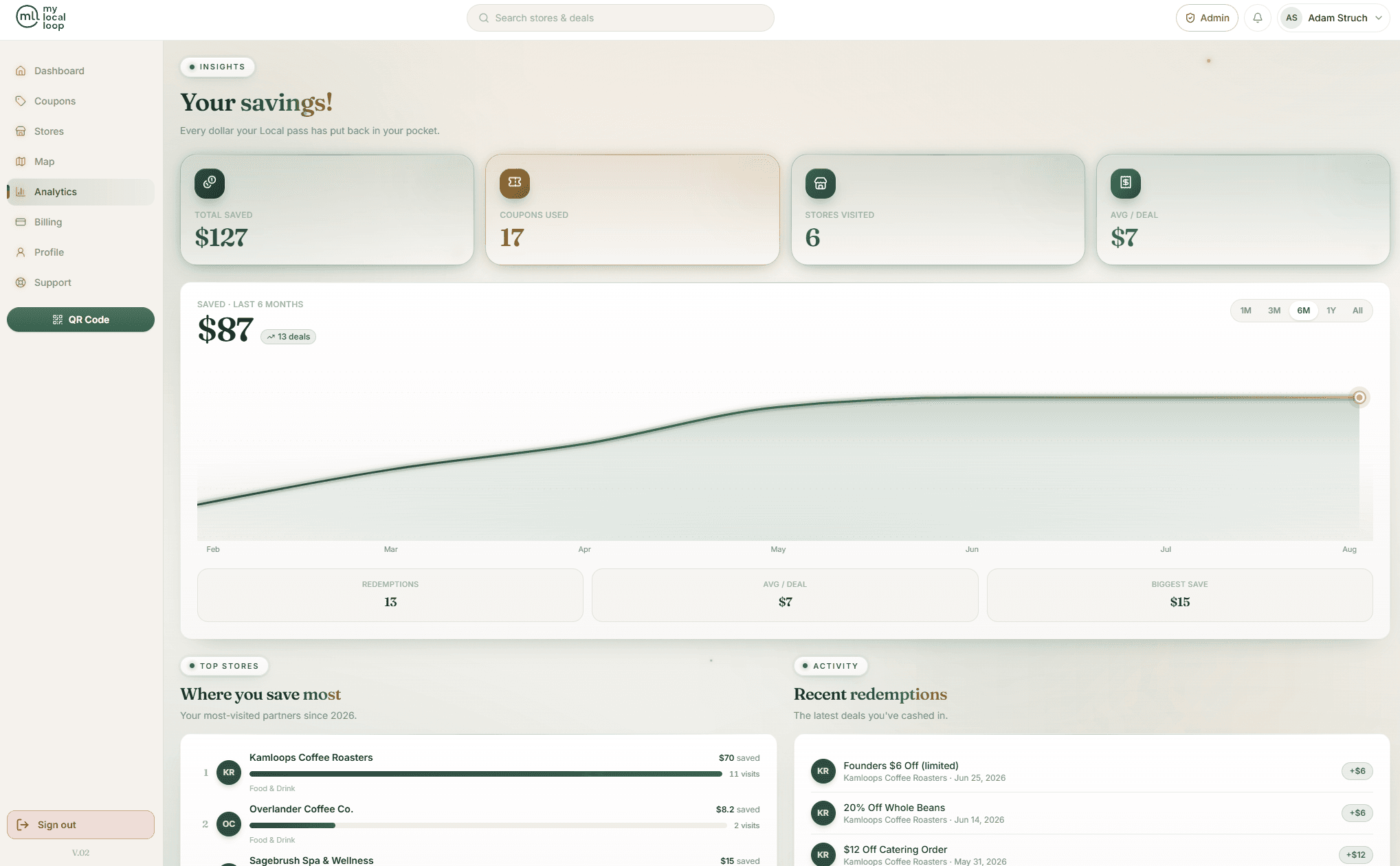
07 / The Local Pass
The bridge between the app and the shop counter.
The Local Pass is where the digital marketplace meets the physical business. Every Local carries a unique QR code and a unique manual customer code.
At checkout the Local presents the QR for the Partner to scan. If the Partner is on a desktop or can't scan, the manual code is entered by hand instead. Either way the system validates the Local and the coupon rules before the redemption is accepted.
Local / Local Pass
↔ Drag2044 × 1255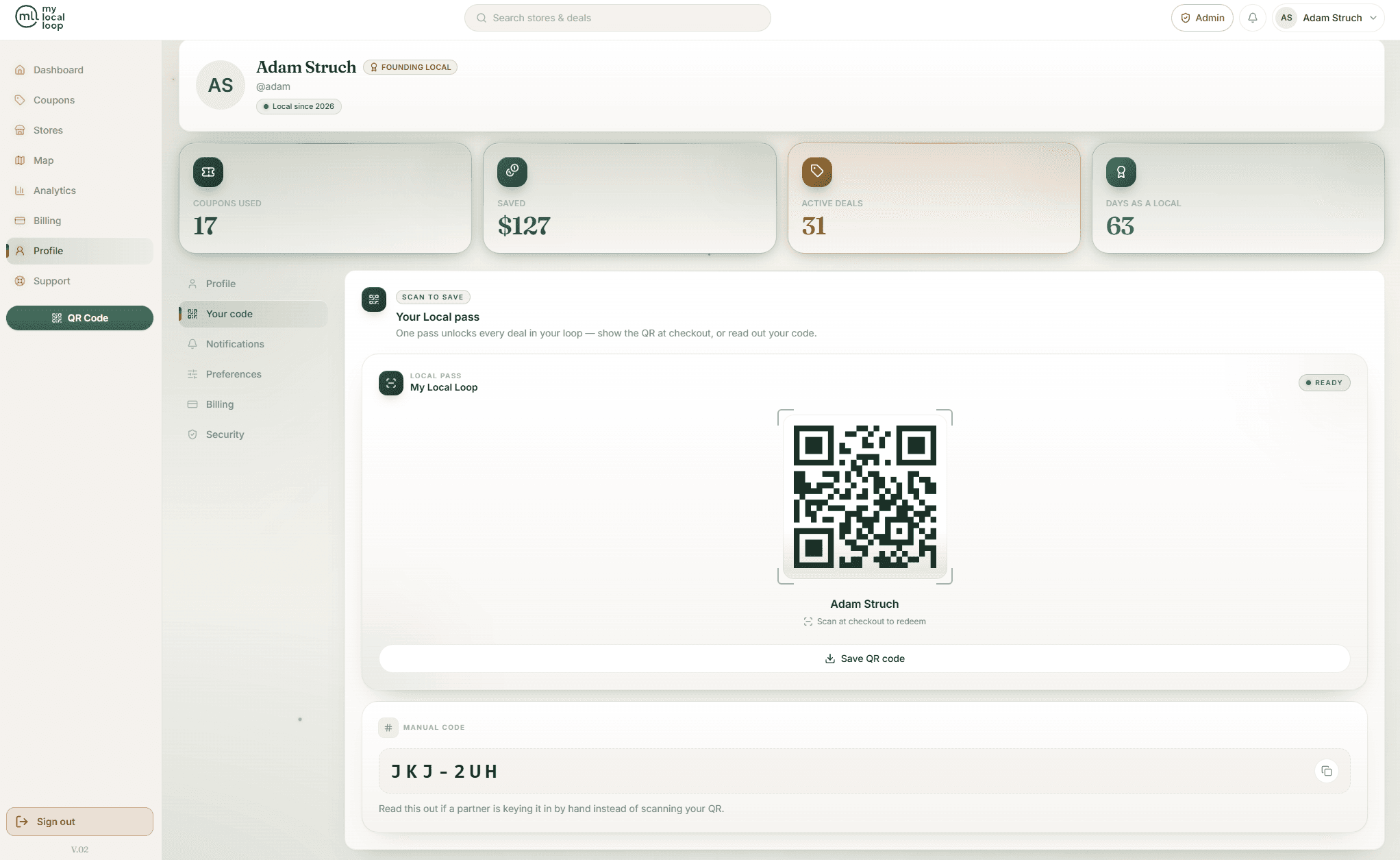
08 / Redemption Architecture
One identity, validated by us — not by every POS.
Giving every Local a platform-controlled identity means a Partner can confirm membership and coupon eligibility through My Local Loop itself, with no integration into their payment system.
Presented as
Validated through My Local Loop
- Partner portalreceives the code01
- Validationis this a real Local?02
- Coupon ruleslimits, dates, eligibility03
- Redeemaccepted04
- Redemption recordedwritten once05
- Analyticsboth sides update06
09 / The Challenge
The hard part was the seam between the two sides.
The Local and Partner experiences are connected but carry completely different permissions and workflows. A Partner should never reach Local-only systems; a Local should never enter Partner administration. Authentication alone wasn't enough — the product needed role-aware authorization throughout.
The second challenge was redemption. Integrating into every business's payment or POS system would be an enormous burden, especially in beta. So My Local Loop owns the redemption layer instead.
The best integrationwas no integration.
By giving every Local a platform-controlled identity through their QR and manual code, Partners validate membership and coupon eligibility through My Local Loop — keeping redemption independent of whatever system already sits on their counter.
One marketplace.Two completelydifferent users.
10 / The Partner Experience
The other side of the loop is the operational one.
Once a Local redeems an offer, the Partner side becomes the operational view of that activity — redemptions, repeat customers, active coupons and how each offer is performing.
Partner / Dashboard
↔ Drag2043 × 1255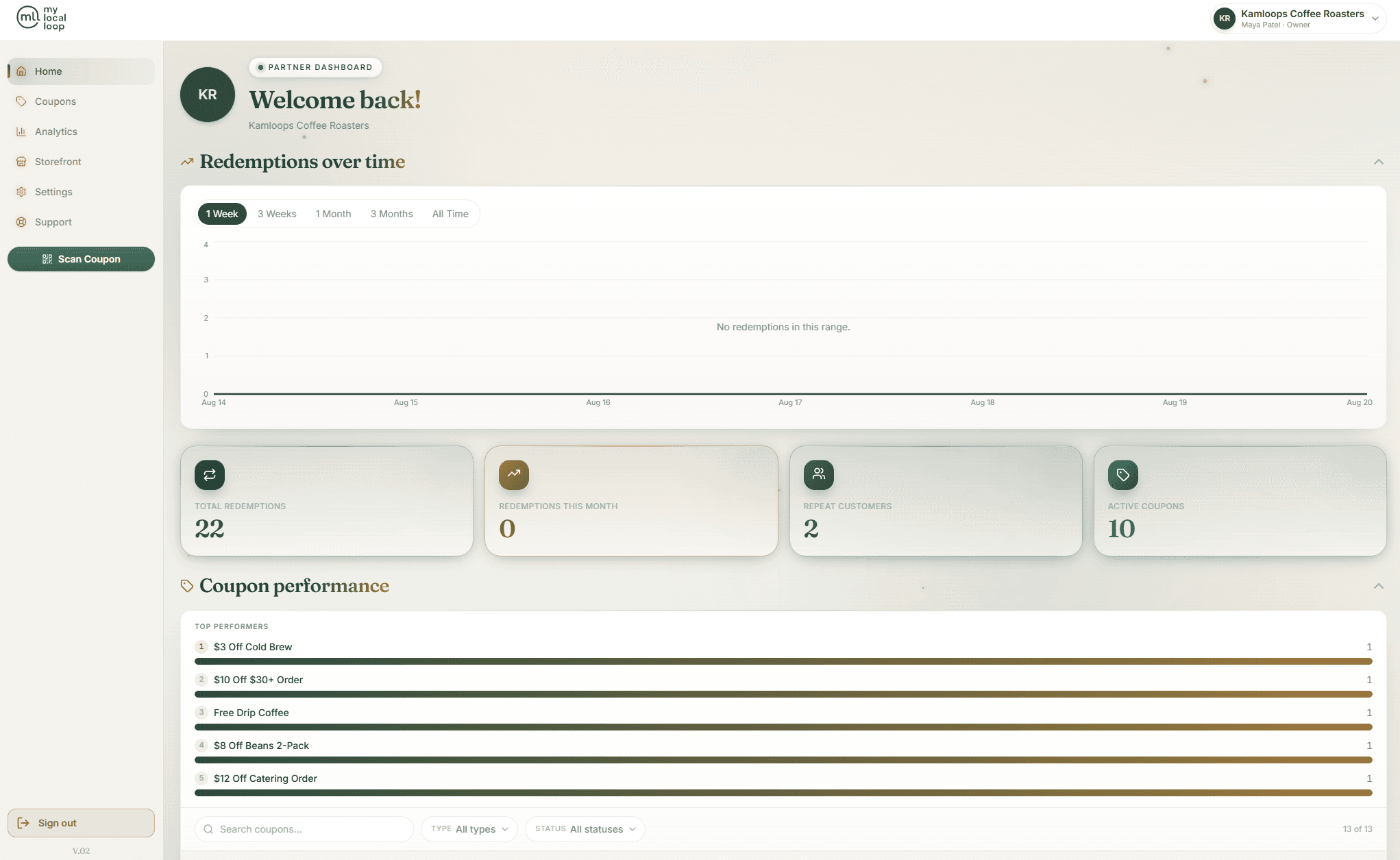
11 / The Offer Builder
This is where the marketplace's supply is made.
Offers are created by the Partner, not by us. A Partner sets the title, description, imagery and category; picks a discount type and amount; schedules a start and expiry (or marks it non-expiring); and sets a per-customer limit or allows unlimited redemptions.
Partner / Offer builder
↔ Drag2038 × 1259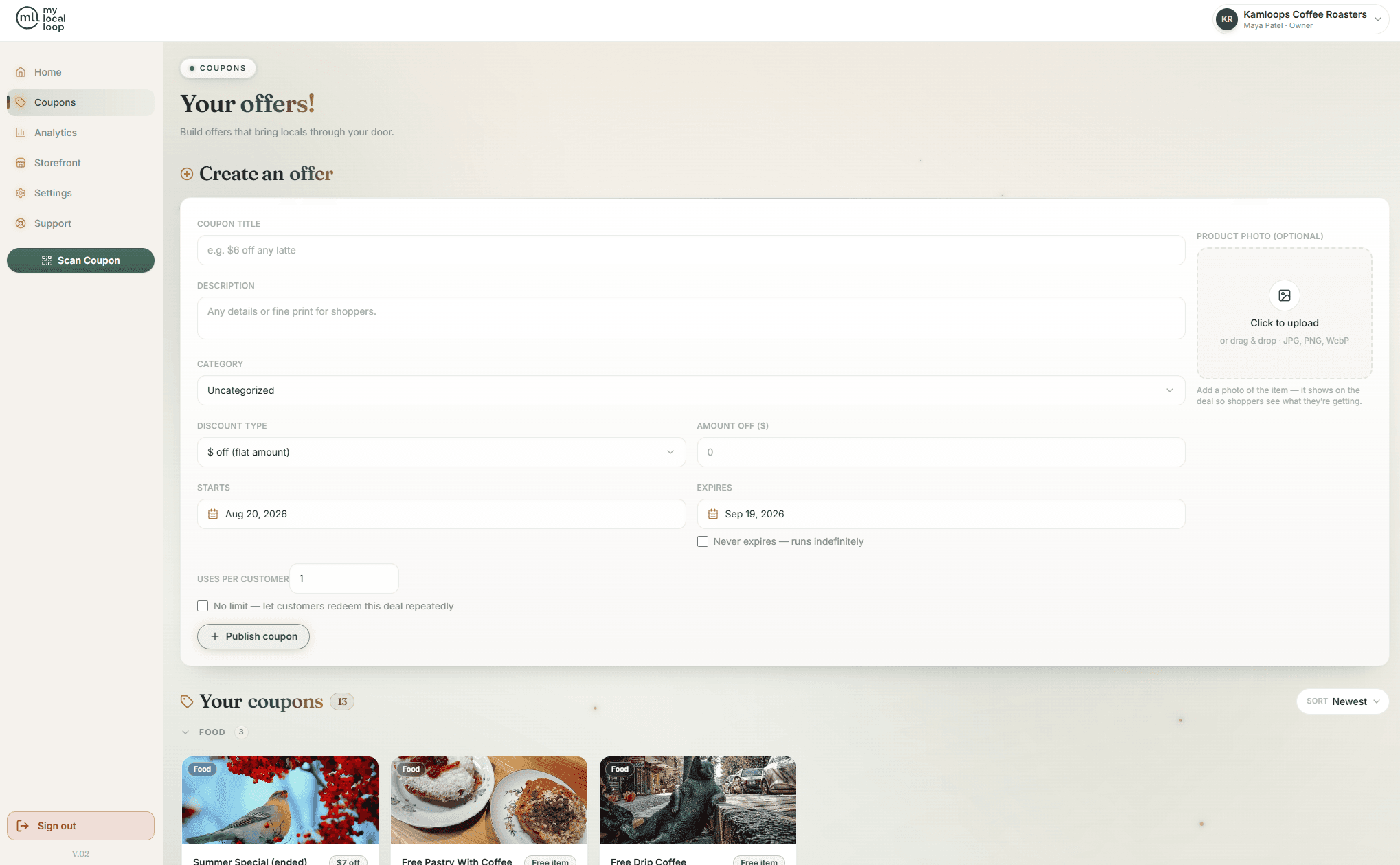
12 / The Feedback Loop
Nothing stops when the coupon is redeemed.
Partners can read redemptions, revenue attributed to redemptions, unique customers, average savings, redemption trends, discount mix, and new versus returning customers. What a Partner creates becomes inventory the Local discovers — and what the Local redeems becomes the signal that shapes the next offer.
Partner / Analytics
↔ Drag2038 × 1258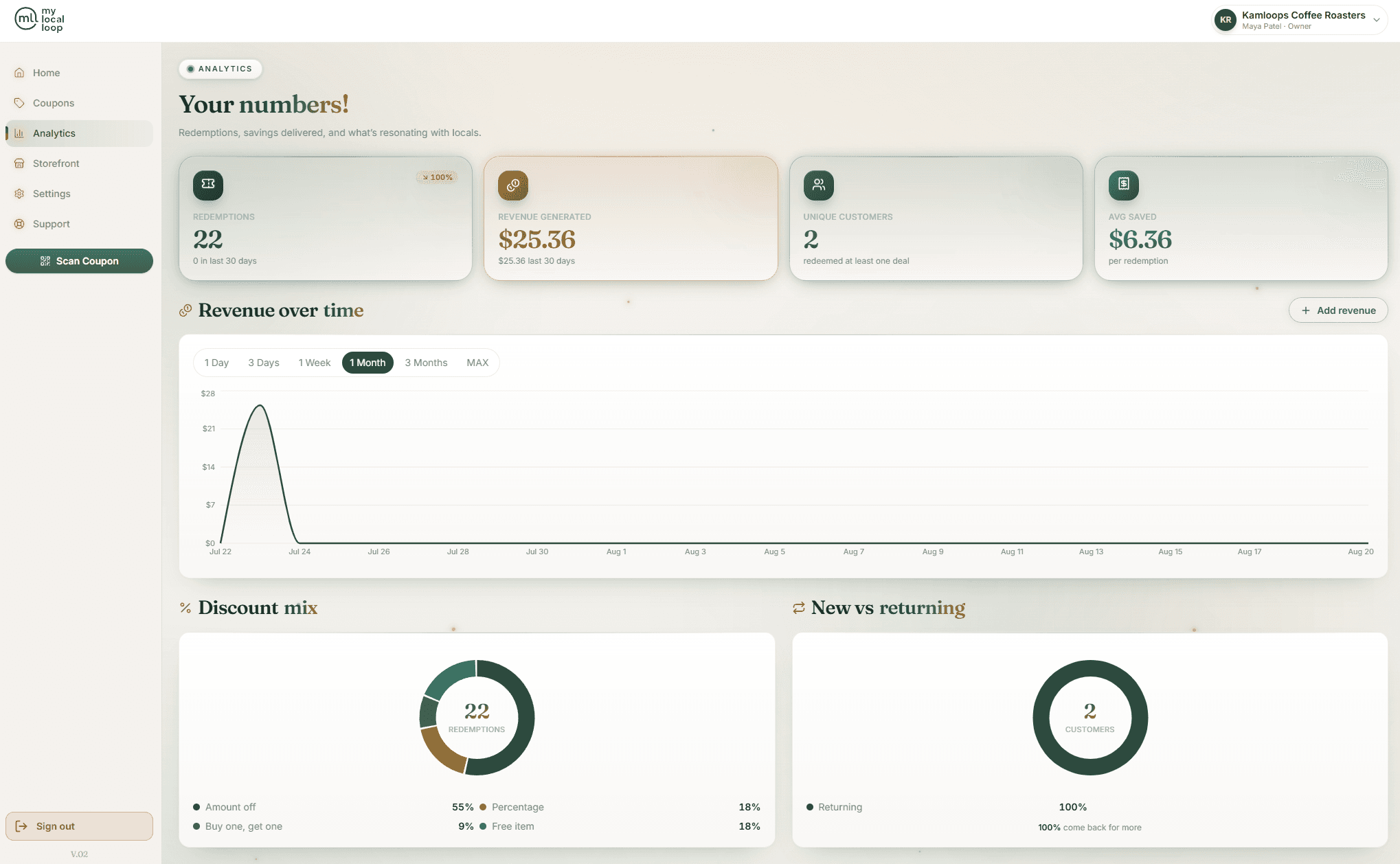
Partner / Storefront
↔ Drag2039 × 1259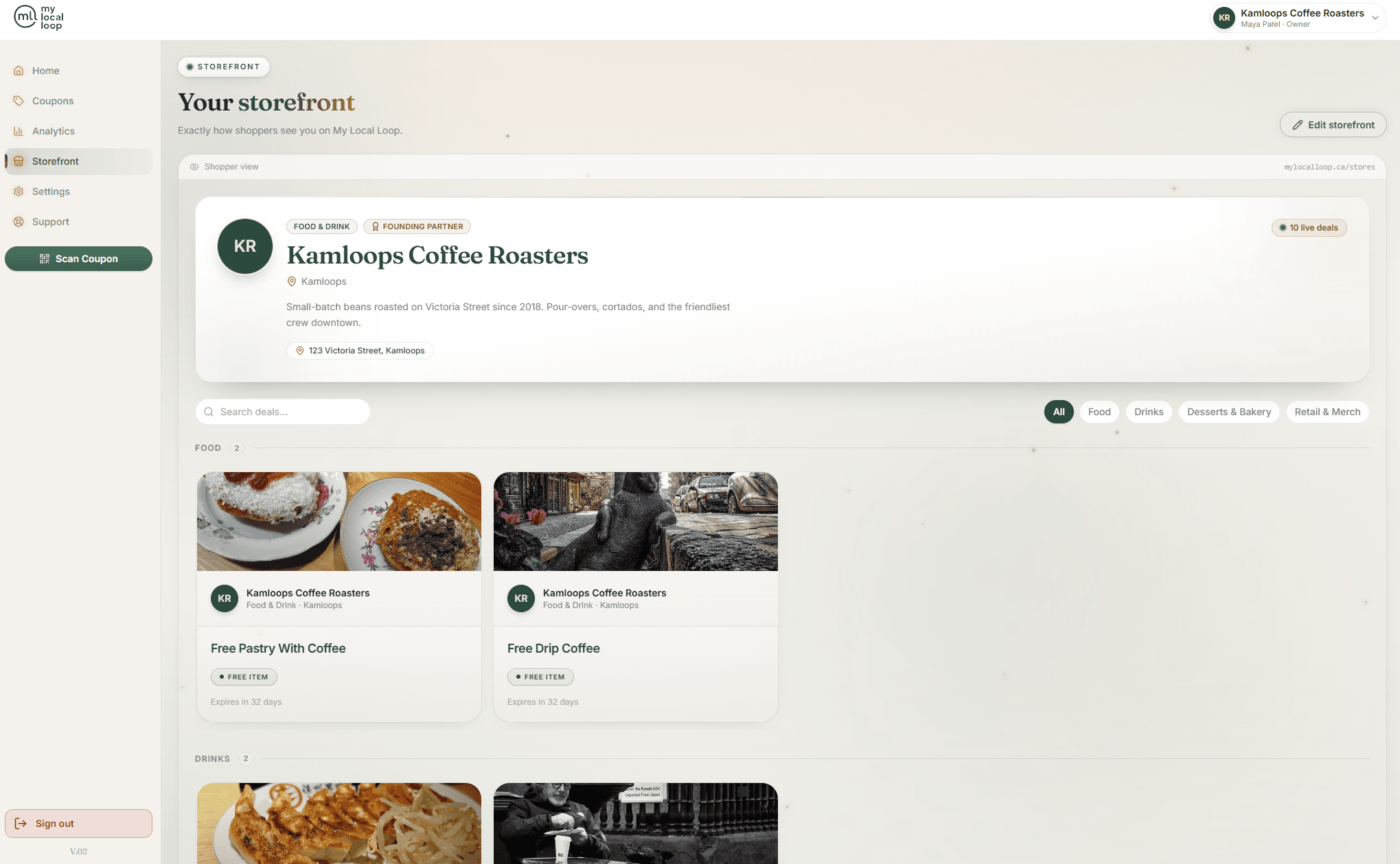
13 / The Build
A two-sided product, drawn the way it stacks.
My Local Loop is built with Next.js, React and TypeScript on Tailwind, with PostgreSQL on Neon through Prisma, Clerk for authentication, Stripe for subscriptions, Upstash Redis, Zod and react-markdown. Database migrations are applied manually through Neon, and it's hosted on Vercel.
Authenticate through one layer
Services
Systems on the marketplace
14 / Validation
Not a prototype — a marketplace in use.
My Local Loop is operating in a closed beta. These are validation numbers, not growth metrics: real businesses and real consumers are on the platform and redeeming offers.
Feedback from participating businesses has been positive, and the beta keeps surfacing bugs, mobile improvements, onboarding refinements and operational requirements — all being addressed before broader expansion.
20
Participating businesses
12
Consumers
Kamloops
Core market
Live
Coupon redemptions
15 / What I Learned
A marketplace is a different kind of problem.
Building this showed me how different a two-sided marketplace is from a single-user SaaS product. Every decision affects two groups. A great Local experience means little if Partners find offer creation hard; a powerful Partner dashboard means little if Locals don't see enough value to subscribe. The loop only moves when both sides get enough.
Security mattered more than I expected. Authentication alone wasn't enough — the application needed authorization that understood who the user is and what they're permitted to do.
Who you are.What you're allowed to do.Not the same question.
16 / What's Next
Still being built. Still being proven.
My Local Loop remains in active development. Kamloops is the core market, additional cities are applying, and expansion is being introduced gradually. The dedicated consumer app is in development.
- 01Onboard more PartnersKeep growing the supply side of the marketplace.
- 02Grow consumer adoptionBring more Locals into the loop.
- 03Harden the betaFix bugs and keep improving the mobile experience.
- 04Expand carefullyMove into additional cities as they're ready.
- 05Ship the appComplete the dedicated consumer application.
17 / Why I Built It
It started as trust between two partners.
My business partner had seen products I'd built before and trusted me to take the idea behind My Local Loop and turn it into a working platform. That trust let me own the product from concept through implementation.
I also care about the problem. Independent businesses increasingly compete with companies whose resources they can't match. My Local Loop is a chance to build technology that helps them attract customers without adding another marketing expense — an idea between two partners that's now a working marketplace being used by real businesses and consumers.
Two partners.One idea.A working marketplace.